

Skip to content

Integration and Tensions

Lean, Digital technology and Circular Economy change the same production system. Their goals often support one another, yet they can also impose competing demands. Digital Green Lean helps leaders keep both sides in view and review their choices as conditions change.

A yellow signpost with arrows pointing in opposite directions

The four tensions

Operational tensions

These are the four operational tensions developed in the doctoral research. They do not promise a permanent resolution; they must be navigated in each particular context.

Efficiency vs. Circularity

Lean flow seeks stability and less waste; Circular loops can bring variable materials and reverse flows.

How can a plant maintain efficient, stable throughput while increasing recovered input whose characteristics vary from batch to batch?

How to manage it

Manage material variability with dedicated Circular streams and appropriate performance criteria. Use A3 problem solving and review operational and Circular metrics together.

Keep in view: This can add local inventory or coordination effort; review whether the wider resource benefit justifies it.
These management responses draw on chapters 7 and 8 of the doctoral research. They support ongoing judgement rather than eliminate the tensions. Read the thesis.

A connected explanation

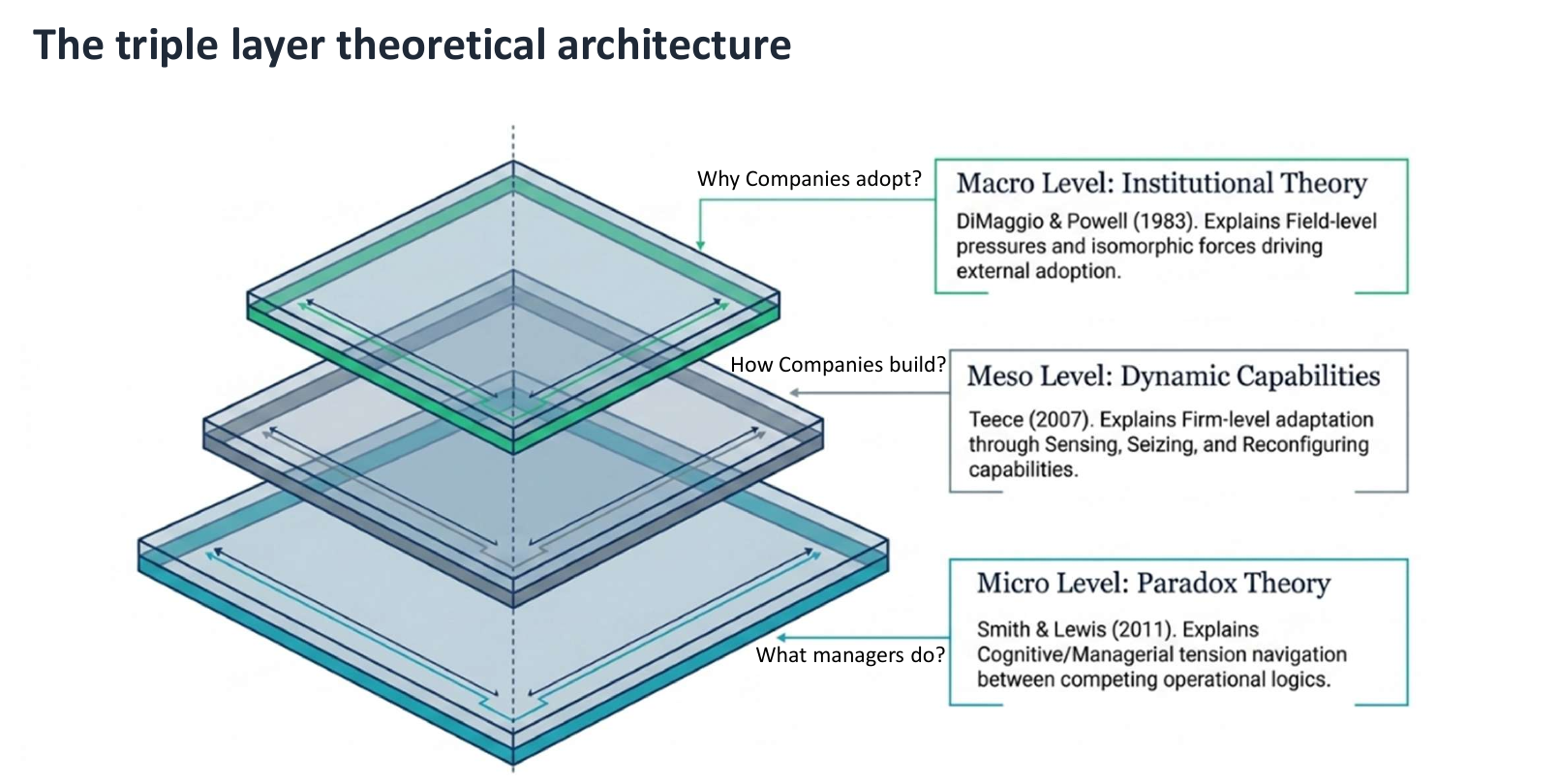
Three levels of explanation

Each theory answers a different question. The levels interact, and tension management remains necessary across all three.

Triple layer theoretical architecture: macro level institutional theory, meso level dynamic capabilities, micro level paradox theory
Triple layer theoretical architecture from the doctoral defence presentation.

External pressures, organisational capabilities and managerial choices meet in the same transformation. Digital Green Lean connects the three levels when examining the tensions in daily operations.

Innovation

Five channels of innovation

Digital Green Lean treats innovation as a capability of the operating system — its culture, its routines and its leadership — rather than a separate department. Five channels carry it into daily operations. Each has a different rhythm and involves a different group of people:

01

Process innovation · Kaizen Teian

Continuous · everyone

Improvement proposed from the shop floor through the suggestion system. Operators surface problems and ideas in their own work, and management evaluates them with visible follow-up. The value comes from the volume and constancy of small steps, supported by standard work and respect for people.

The five channels meet the same four operational tensions described above: more ideas, faster events and richer data can strain stable standards, flow and the capabilities of the people who must act on them. Innovation, too, is navigated rather than installed.

Engage

Bring an industrial tension to the discussion

Start with a defined process, technology or circularity question. We can agree what evidence to examine and who needs to take part.

Contact us